AI in the Oncology Service Line
High-level implementation considerations
Sean Davis, MD, PhD
Monday, October 28, 2024
Artificial Intelligence Overview
Artificial Intelligence (AI) is the simulation of human intelligence processes by machines, especially computer systems. These processes include learning (the acquisition of information and rules for using the information), reasoning (using rules to reach approximate or definite conclusions), and self-correction.
An Ontology of AI
AI vs. ML vs. Deep Learning
Artificial
Intelligence
Machine
Learning
Deep
Learning
AI vs. ML vs. Deep Learning
Artificial
Intelligence
Machine
Learning
Deep
Learning
Campus Large Language Models
Framework
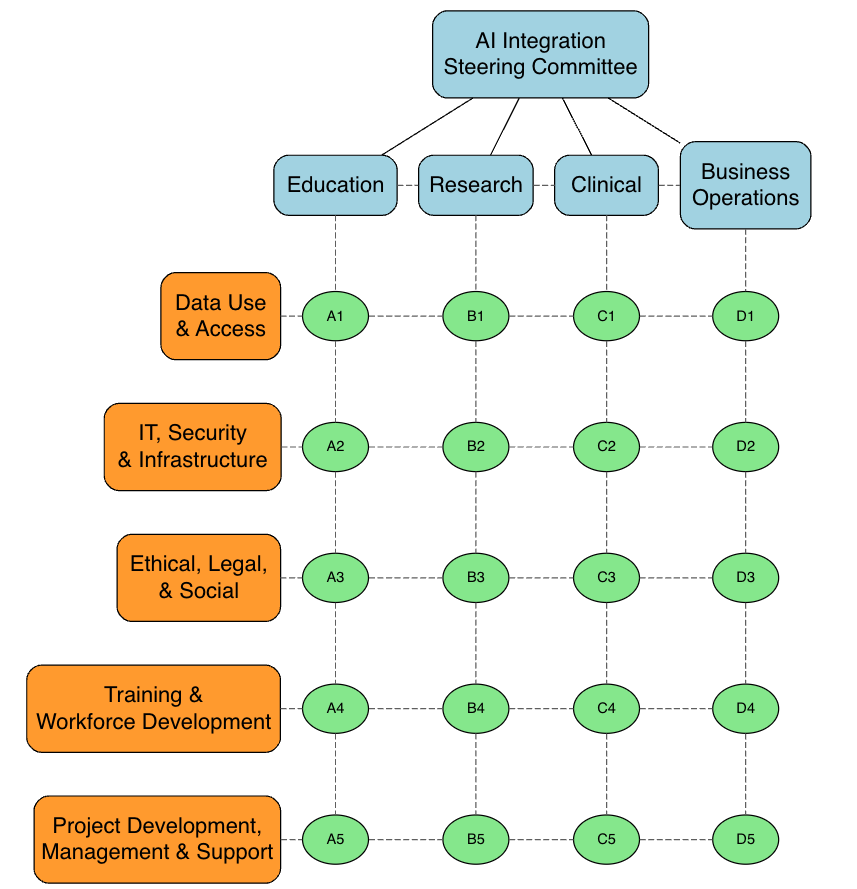
A schematic framework for organizing workstreams (orange boxes), domains (blue boxes), and work products and tasks (green ovals). Domains (vertical dimension) capture semi-independent organizations, each with largely independent use cases, budgets and business plans, priorities, and leadership. The workstreams (horizontal dimension) will often require similar or overlapping expertise, and can serve as knowledge resources to provide synergy and uniformity in implementation across domains.
Vision Statement
LLMs must be used in a manner consistent with the mission, vision, and values of the academic hospital system.
The use of LLMs must align with relevant legal and regulatory requirements, including but not limited to data privacy, security, and intellectual property laws.
The deployment of LLMs should prioritize patient safety, privacy, and wellbeing.
LLMs must be used in a transparent manner, with users understanding the capabilities and limitations of the technology.
Continuous improvement and evaluation of LLM usage should be prioritized to ensure ongoing alignment with organizational goals.
Stakeholder Considerations
Patients
LLMs should be used to augment patient care and improve outcomes, without replacing the human touch and empathy of healthcare providers.
Patients must be informed about the use of LLMs in their care, and they should have the option to opt out if desired.
Patient data used in LLM applications must be anonymized, encrypted, and securely stored to protect patient privacy.
Healthcare Providers
LLMs should be deployed to enhance clinical decision-making and efficiency without undermining the autonomy and expertise of healthcare providers.
Adequate training and support should be provided to healthcare providers to ensure proper use and understanding of LLMs.
Feedback from healthcare providers must be regularly solicited to improve LLM performance and usability.
Researchers
The use of LLMs in research must adhere to ethical standards, including obtaining informed consent and minimizing potential harm.
Collaboration between researchers and LLM developers should be encouraged to drive innovation and address specific research needs.
Research involving LLMs should be transparent and reproducible, with results and methodologies made available to the wider scientific community.
Administrators and Support Staff
LLMs should be deployed in administrative and support functions to improve efficiency, reduce costs, and enhance the overall quality of service.
Staff should receive appropriate training and support to understand and utilize LLMs effectively.
Employee feedback should be actively sought to identify areas of improvement and potential new applications for LLMs.
Monitoring and Compliance
A designated LLM Steering Committee, comprising representatives from various stakeholder groups, will be responsible for monitoring and enforcing compliance with this policy.
Periodic audits and assessments will be conducted to ensure adherence to this policy and identify areas for improvement.
Policy violations may result in disciplinary action, up to and including termination of employment or access to LLMs
Guiding Principles for use of AI tools in healthcare
Principle 1: Alleviate Health Disparities
- AI tools must be intentionally designed to reduce known disparities
- Key strategies:
- Ensure disadvantaged groups have equal access and benefit
- Preferentially design tools for disadvantaged populations
- Consider:
- Training on balanced, unbiased datasets
- Using accessible, routinely collected data points
- Designing for low-resource settings
- Ensuring access to follow-up care
Principle 2: Report Clinically Meaningful Outcomes
- Outcomes must align with established clinical metrics of success
- Consider:
- Evolution of outcome measures over time
- Current standards in the field
- Both short and long-term metrics
- Clinician evaluation needs
- Tools must enable assessment of:
- Accuracy
- Fairness
- Risks
- Healthcare value
- Interpretability
Principle 3: Reduce Overdiagnosis and Overtreatment
- Balance sensitivity with specificity
- Consider:
- Definition of overdiagnosis in specific context
- Physical, emotional, and financial costs
- Evolution of disease understanding
- Disease progression patterns
- Design tools to:
- Differentiate disease subtypes
- Tailor interventions to disease severity
- Minimize unnecessary treatment
Principle 4: Have High Healthcare Value
- Deliver better outcomes for same cost OR same outcomes for less cost
- Consider:
- Implementation costs
- Maintenance costs
- Update costs
- Error costs (immediate and downstream)
- Resource allocation priorities
- Healthcare system capacity
- Avoid diverting resources from higher-priority areas
Principle 5: Incorporate Biography
- Consider patient’s lived experience beyond biology
- Include factors such as:
- Social exposures
- Structural conditions
- Environmental exposures
- Emotional states
- Allostatic load
- Access to care
- Start with available data:
- Zip codes
- Socioeconomic scales
- Geospatial information
- Plan to improve resolution over time
Principle 6: Be Easily Tailored to Local Population
- Focus on local precision over broad generalizability
- Design considerations:
- Use easily collected inputs
- Ensure reliable training features across populations
- Enable local retraining
- Publish open AI workflows
- Provide platforms for local model training
- Recognize limitations of generalizability across:
- Populations
- Healthcare systems
- Time periods
Principle 7: Promote a Learning Healthcare System
- Build continuous learning into design
- Include:
- Regular evaluation mechanisms
- Performance standards
- Timeframes for assessment
- Integration of new knowledge
- Analyze:
- Who the tool doesn’t work for
- Why it doesn’t work
- Impact on patients
- Impact on healthcare system
- Provide framework for improvement
Principle 8: Facilitate Shared Decision-Making
- Enable understanding of AI decisions
- Design considerations:
- Use explainable algorithms
- Prioritize interpretability
- Consider simpler algorithms
- Generate continuous scores vs. fixed thresholds
- Support:
- Patient understanding
- Provider understanding
- Integration of patient values
- Risk preference considerations
Implementation Considerations
Local Concerns
- Data classification
- Access to AI tools
- UCHealth/University partnership
- Resource allocation
- Training and support
- Prioritization of projects
- Commercial partnerships
- Oversight and governance