The History of Artificial Intelligence and Machine Learning
Sean Davis, MD, PhD
Thursday, September 19, 2024
Introduction
- Artificial Intelligence (AI) and Machine Learning (ML) have a rich history
- From early concepts to modern applications
- This presentation covers key milestones and breakthroughs
Early Beginnings (1940s-1950s)
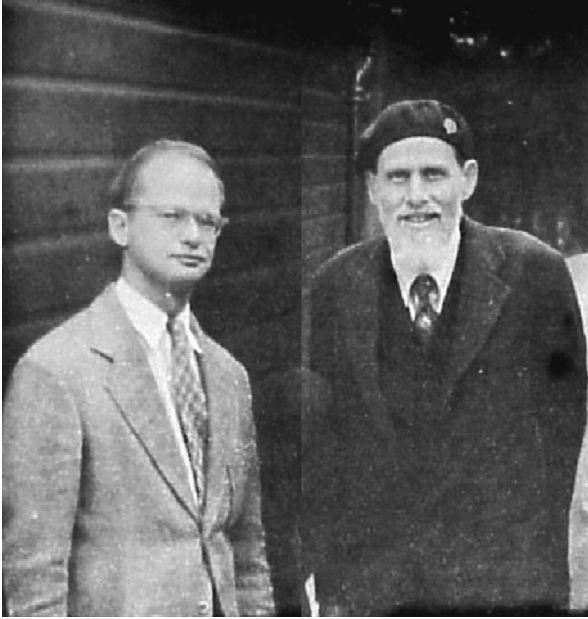
- 1936: Turing and the Computable Numbers (Turing 1936)
- 1943: McCulloch and Pitts create a computational model for neural networks
- 1950: Alan Turing proposes the Turing Test (Turing 1950) and Paper
- 1956: Dartmouth Conference coins the term “Artificial Intelligence”
“I, Robot” by Isaac Asimov
- Published in 1950 by Gnome Press
- Collection of nine science fiction short stories
- Originally appeared in super-science fiction magazines (1940-1950)
- Introduced the concept of positronic robots and the Three Laws of Robotics
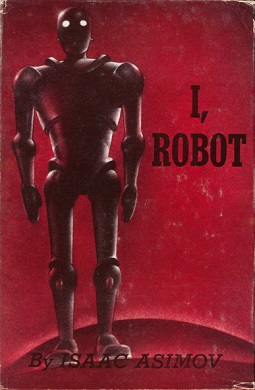
Asimov (1950)
The Three Laws of Robotics
- A robot may not injure a human being or, through inaction, allow a human being to come to harm.
- A robot must obey the orders given it by human beings except where such orders would conflict with the First Law.
- A robot must protect its own existence as long as such protection does not conflict with the First or Second Laws.
Asimov later added the Zeroth Law that superseded the others:
- A robot may not harm humanity, or, by inaction, allow humanity to come to harm.
“I, Robot”’s Influence on Modern AI
- Sparked discussions on machine ethics and AI safety
- Influenced researchers to consider ethical implications of AI development
- Concept of “friendly AI” draws parallels to Asimov’s laws
- Challenges presented in stories mirror real-world AI alignment problems
1950: The Turing Test
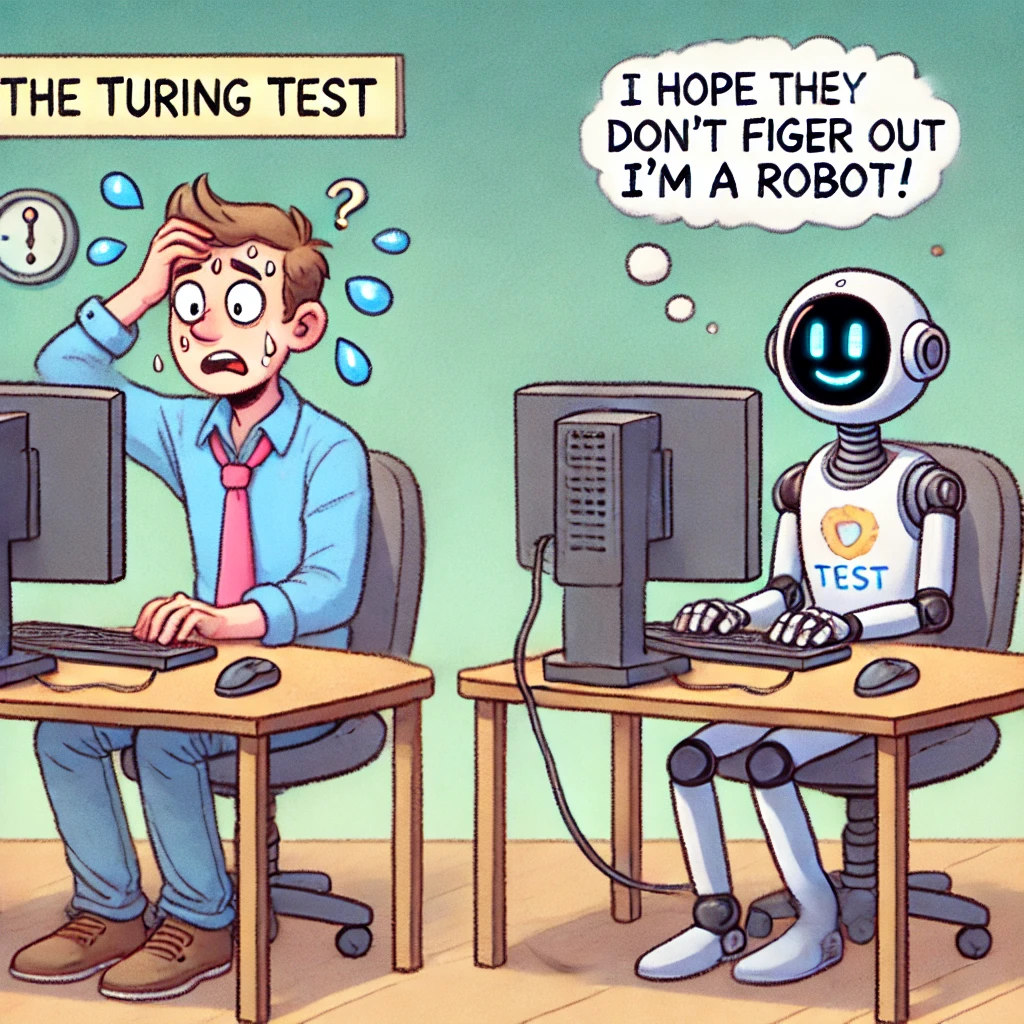
Who’s the real human?
The Golden Years (1956-1974)
- Development of early AI programs
- 1957: Frank Rosenblatt develops the Perceptron
- 1964: ELIZA, one of the first chatbots, is created by Joseph Weizenbaum
1964: ELIZA, one of the first chatbots

Although ELIZA was limited in terms of actual understanding, it marked an important milestone in the development of AI and human-computer interaction, showing how conversation-based interfaces could influence the perception of intelligence.
Expert Systems Era (1970s-1980s)
Expert Systems in Artificial Intelligence
What is an Expert System?
- Definition: Computer program that emulates decision-making ability of a human expert
- Key Components:
- Knowledge Base: Contains domain-specific information and rules
- Inference Engine: Applies rules to the knowledge to derive new information
- User Interface: Allows non-expert users to interact with the system
- Characteristics:
- Solves complex problems by reasoning through bodies of knowledge
- Separates domain knowledge from the reasoning mechanism
- Can explain its decisions and reasoning
What is an Expert System?
- Applications:
- Medical diagnosis (e.g., MYCIN)
- Financial planning
- Manufacturing process control
- Scientific analysis
- Advantages:
- Consistent and accurate decisions
- Preservation of expert knowledge
- Ability to handle complex scenarios
- Limitations:
- Limited to specific domains (narrow AI)
- Difficulty in capturing tacit knowledge
- May struggle with unusual or unprecedented situations
Example Expert system: MYCIN
- Developed in the early 1970s at Stanford University
- One of the first rule-based expert systems in medicine
- Purpose: Assist physicians in diagnosing and treating bacterial infections
- Focused on bloodstream infections (bacteremia and meningitis)
- Named after antibiotics (many of which end in “-mycin”)
MYCIN: Key Features and Functionality
- Rule-based system with approximately 600 rules
- Used backward chaining inference engine
- Incorporated certainty factors to handle uncertainty
- Asked users a series of yes/no questions about symptoms and test results
- Provided diagnosis recommendations and suggested antibiotic treatments
- Explained its reasoning process to user
MYCIN: Impact and Legacy
- Never used in clinical practice due to ethical and legal concerns
- Achieved performance comparable to human experts in its domain
- Pioneered several important concepts in AI and expert systems:
- Separation of knowledge base from inference engine
- Explanation of reasoning
- Handling of uncertainty
- Influenced development of subsequent expert systems and clinical decision support tools
- Demonstrated potential of AI in healthcare, paving way for modern medical AI applications
AI Winter (1974-1980 and 1987-1993)
- Periods of reduced funding and interest in AI
- Overpromising and underdelivering led to skepticism
- Shift towards more practical, focused applications
Revival of Machine Learning (1990s)
- Increased focus on data-driven approaches
- 1997: IBM’s Deep Blue defeats world chess champion Garry Kasparov
- Growing interest in neural networks and statistical methods
“Technological Triggers for the Rise of ML and AI in the 2000s”
Increased Computational Power
- Advancement:
- Rapid growth of CPUs and the emergence of GPUs (Graphics Processing Units).
- Impact:
- Enabled the training of deeper neural networks essential for various AI tasks.
Big Data
- Advancement:
- Explosion of digital data from the internet, social media, and sensors.
- Impact:
- Facilitated the development of accurate models as ML algorithms require substantial data to learn effectively.
Open Source Frameworks and Libraries
- Advancement:
- Emergence of libraries like TensorFlow (2015), Keras (2015), and Scikit-learn (2007).
- Impact:
- Lowered the barrier for AI development, allowing more practitioners to innovate in the field.
Advances in Algorithms
- Advancement:
- Research in new algorithms, such as support vector machines and deep learning architectures.
- Impact:
- Improved AI performance across applications, particularly in image and speech recognition.
Cloud Computing
- Advancement:
- Rise of cloud computing platforms (e.g., AWS, Google Cloud, Microsoft Azure).
- Impact:
- Provided scalable resources for storage and computation, enabling extensive ML experimentation.
Collaborative Research and Knowledge Sharing
- Advancement:
- Increased collaboration and sharing of findings through conferences and online platforms.
- Impact:
- Accelerated innovation in AI and ML as researchers built upon each other’s work.
Investment and Interest from Industry
- Advancement:
- Growing interest and investment from tech giants and startups in AI technologies.
- Impact:
- Led to the development of practical applications and commercial products, driving further research.
The 2000s: The Rise of Big Data and Deep Learning
Deep Learning Resurgence (2006)
- Milestone: Geoffrey Hinton and team introduced “deep belief networks.”
- Impact: Marked the resurgence of deep learning and laid the foundation for modern AI applications, especially in image and speech recognition.
AlexNet Wins ImageNet Competition (2012)
- Milestone: Alex Krizhevsky, Ilya Sutskever, and Geoffrey Hinton’s deep neural network (AlexNet) won the ImageNet competition.
- Impact: Showcased the power of convolutional neural networks (CNNs) and triggered widespread adoption in computer vision tasks.
IBM Watson Wins Jeopardy! (2011)
- Milestone: IBM Watson defeated champions Ken Jennings and Brad Rutter on Jeopardy!.
- Impact: Demonstrated AI’s ability to process and understand natural language, leading to applications in healthcare, finance, and customer service.
MD Anderson sets Watson aside (2017-2018)
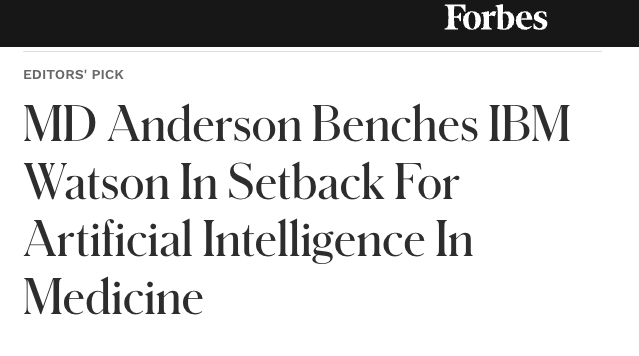
See Herper (n.d.)
Generative Adversarial Networks (GANs) (2014)
- Milestone: Ian Goodfellow introduced GANs, a model where two neural networks compete to generate realistic data.
- Impact: Revolutionized image generation and unsupervised learning, powering innovations like deepfakes and AI-generated art.
AlphaGo Defeats World Champion (2016)
- Milestone: Google DeepMind’s AlphaGo defeated Go champion Lee Sedol.
- Impact: Showcased the capability of reinforcement learning and deep neural networks in mastering complex strategic games.
Transformer Architecture (2017)
- Milestone: Vaswani et al. introduced the Transformer model, revolutionizing natural language processing.
- Impact: Laid the groundwork for state-of-the-art NLP models like BERT and GPT, transforming language understanding and generation.
AI and ML in Social Media (2010s)
- Milestone: Social media platforms adopted AI for content recommendation and moderation.
- Impact: Enhanced user engagement and experience, but also raised concerns about echo chambers, misinformation, and algorithmic bias.
AlphaFold Solves Protein Folding (2020)
- Milestone: DeepMind’s AlphaFold achieved breakthrough accuracy in predicting protein structures.
- Impact: Solved a 50-year-old challenge in biology, opening new doors in drug discovery and molecular biology.
GPT-4 and Large Language Models (2023)
- Milestone: OpenAI’s GPT-4 showcased the potential of large-scale language models for complex, nuanced language understanding.
- Impact: Accelerated the development of AI-driven content creation and enhanced human-computer interaction.
Future Directions
- Artificial General Intelligence (AGI) research
- Quantum computing and AI
- Neuromorphic computing
- Human-AI collaboration
For deeper dive into the history, see (Norman 2024).
Challenges and Opportunities
- Ethical AI development
- AI governance and regulation
- Addressing AI bias and fairness
- Balancing innovation with responsible development
References
Asimov, Isaac. 1950. I, Robot. Bantam hardcover ed. (2). New York: Bantam Books.
Herper, Matthew. n.d. “MD Anderson Benches IBM Watson In Setback For Artificial Intelligence In Medicine.” Forbes. Accessed October 2, 2024. https://www.forbes.com/sites/matthewherper/2017/02/19/md-anderson-benches-ibm-watson-in-setback-for-artificial-intelligence-in-medicine/.
Norman, Jeremy. 2024. “History of Information.” https://www.historyofinformation.com/?cat=71.
Turing, Alan. 1936. “On Computable Numbers, with an Application to the Entscheidungsproblem.” https://www.abelard.org/turpap2/tp2-ie.asp.
———. 1950. “Computing Machinery and Intelligence.” Mind 59 (October): 433–60. https://doi.org/10.1093/mind/lix.236.433.